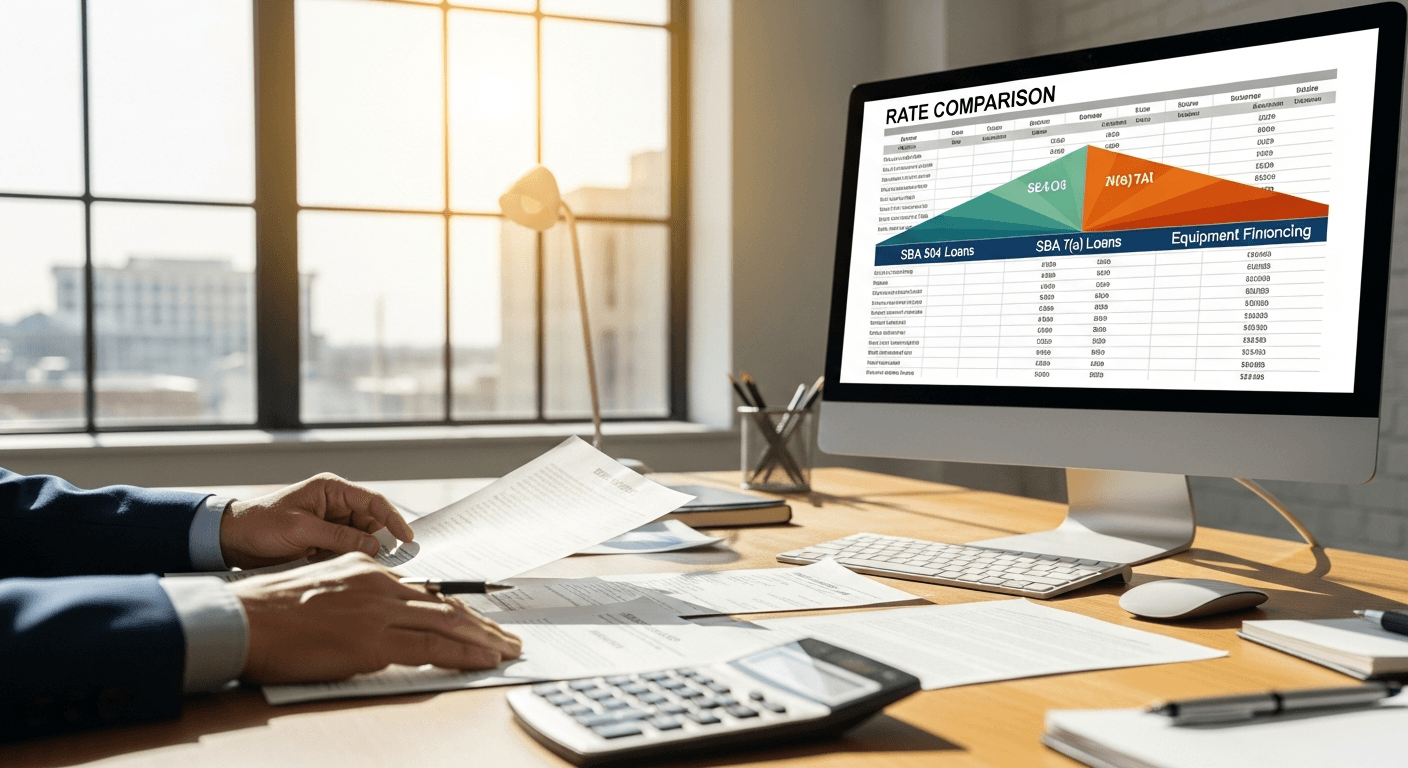
SBA Loan Rates: Current 504 & 7(a) Rates and Payment Examples
SBA Loan Rates: Current 504 & 7(a) Rates and Payment Examples
If you're shopping for SBA loan rates in 2026, here's what you need to know: SBA 504 loans currently start around 6.5% APR, while SBA 7(a) loans run closer to 7.0% APR. These rates are tied to different benchmarks—504 loans track U.S. Treasury yields, and 7(a) loans follow the Prime Rate—which means your actual monthly payment and total interest cost can vary significantly depending on which program you choose.
At 3A Lending, we've helped hundreds of business owners across all 50 states understand these rate differences and find the right financing structure for their goals. This guide breaks down how SBA loan rates are set, what you'll actually pay each month on a typical loan, and why the current market creates a smart refinancing opportunity for 7(a) borrowers who qualify for 504 programs.
What Is the Difference Between SBA 504 Loans at 6.5% APR and SBA 7(a) Loans at 7.0% APR?
SBA 504 loans at 6.5% APR are specifically designed for real estate purchases and large equipment acquisitions. The 504 program uses a three-party structure: you put down 10%, a Certified Development Company (CDC) provides 40% at a fixed long-term rate tied to Treasury yields, and a traditional lender covers the remaining 50%. This structure produces rates starting around 6.5% APR with 10- to 25-year terms, making monthly payments more affordable for owner-occupied commercial properties and major capital investments.
SBA 7(a) loans at 7.0% APR offer broader flexibility. You can use them for working capital, inventory, equipment, real estate, debt refinancing, or business acquisitions. Because 7(a) loans carry more risk for lenders (only 70–90% SBA guaranty versus 504's 90%), and because they're pegged to the Prime Rate rather than Treasury benchmarks, they typically carry slightly higher rates—currently around 7.0% APR. Terms run up to 25 years for real estate, 10 years for equipment, and 10 years for working capital.
Which one is better for your business? If you're buying owner-occupied commercial real estate or equipment valued over $250,000, the 504's lower rate and longer amortization will save you thousands per month. If you need flexibility—working capital, shorter approval timelines (20–30 days versus 504's 45–60 days), or a loan under $250,000—the SBA 7(a) loan is your best bet despite the slightly higher rate.
How Are SBA Loan Rates Set, and Why Do 504 Rates Follow Treasury Benchmarks While 7(a) Rates Are Tied to Prime Rate?
SBA loan rates are not set by the SBA itself. Instead, they're determined by the underlying benchmark rate plus a lender's markup, SBA guarantee fees, and program-specific costs.
SBA 504 rates are tied to U.S. Treasury yields. When you close a 504 loan, the CDC issues a debenture (a bond) backed by the SBA, and the rate is set to the current 5-year or 10-year Treasury rate plus a small spread (typically 1.5–2.5%). As of April 2026, with 10-year Treasuries hovering near 4.2%, effective 504 rates for most borrowers land around 6.5% APR after accounting for the CDC's servicing fee (1–2% of the debenture portion). This rate is fixed for the life of the loan, protecting you from future rate hikes.
SBA 7(a) rates are tied to the Prime Rate, which currently stands at approximately 7.75%. Lenders add a margin of 2.25–2.75% over Prime (the SBA caps the maximum spread at 2.75% for loans over $50,000). So if Prime is 7.75% and your lender charges Prime + 2.25%, your effective rate is roughly 10.0% APR—but many lenders offering competitive SBA 7(a) loans through programs like ours bring that down to starting rates of 7.0% APR by minimizing their spread and passing SBA guarantee benefits to borrowers.
Why the different benchmarks? The 504 program's structure—long-term, fixed-rate financing backed by a bond market mechanism—aligns with Treasury instruments. The 7(a) program's flexibility and revolving guaranty structure align better with Prime Rate-based commercial lending. The guaranty percentages also matter: 504 loans carry a 90% SBA guaranty, reducing lender risk and enabling lower rates. 7(a) loans carry 70–90% guaranties depending on loan size, so lenders price in slightly more risk.
What Would My Monthly Payment Be on a $500,000 SBA 7(a) Loan at 7.0% APR Over a 10-Year Term?
Let's run the real numbers. A $500,000 SBA 7(a) loan at 7.0% APR over a 10-year term produces a monthly payment of approximately $5,842. Over the life of the loan, you'll pay roughly $201,040 in interest, for a total repayment of $701,040.
If you extend that same loan to a 20-year term at 7.0% APR, your monthly payment drops to $3,876, but your total interest climbs to $430,240—more than double the 10-year scenario. The tradeoff is immediate cash flow relief versus long-term cost.
Now compare that to a $500,000 SBA 504 loan at 6.5% APR over a 20-year term: your monthly payment is approximately $3,742, and total interest is $398,080. You save $134 per month and $32,160 in interest compared to the 7(a) on a 20-year term—and you lock in that rate for two decades.
Use our calculator tool to model your specific loan amount, term, and rate. Small differences in APR compound dramatically over multi-year terms, and seeing your exact numbers helps you make the right choice.
Can I Refinance My Existing SBA 7(a) Loan Into a 504 Loan to Lower My Interest Rate Right Now?
Yes—if your existing 7(a) loan is secured by commercial real estate. The SBA allows refinancing of conventional or 7(a) loans into the 504 program, but only when the collateral is owner-occupied real estate (you must occupy at least 51% of the property). You cannot refinance unsecured debt, working capital loans, or equipment-only 7(a) loans into a 504.
Here's how the math works in practice: Suppose you closed a $400,000 SBA 7(a) loan two years ago at 7.5% APR on a 20-year term. Your monthly payment is approximately $3,216. If you refinance the remaining balance (roughly $370,000) into a 504 loan at 6.2% APR on an 18-year term, your new payment drops to about $2,750—a savings of $466 per month, or $5,592 annually.
Break-even timeline: 504 refinances carry closing costs (CDC fees, appraisal, title, legal) typically totaling 2–3% of the loan amount—around $7,400–$11,100 on a $370,000 refi. At $466 in monthly savings, you break even in 16–24 months and save tens of thousands over the remaining term.
Eligibility requirements: You must have been in business for at least two years, demonstrate stable cash flow, and the property must appraise at a value supporting the refinance. Most borrowers find the 45–60 day CDC approval timeline worth the wait for rate savings that compound over decades.
Why Is 2026 a Smart Time to Refinance SBA 7(a) Loans Into 504s, and How Much Could I Save on Monthly Payments?
April 2026 presents a unique refinancing window driven by the relationship between Prime Rate and Treasury yields. While the Prime Rate has remained elevated near 7.75% (keeping 7(a) rates high), the 10-year Treasury yield has moderated to approximately 4.2%, pulling 504 rates down to the mid-6% range.
The spread between 7(a) and 504 rates is currently wider than historical averages—roughly 100–150 basis points (1.0–1.5%). When you refinance from a 7(a) loan originated in 2023–2024 (when Prime spiked and many borrowers locked in 8.0–9.0% APR) into a current 504 at 6.2–6.5% APR, the savings are substantial.
Real-world scenario: A $600,000 real estate loan at 8.5% APR on a 7(a) (common in late 2023) costs approximately $4,661/month on a 20-year term. Refinancing into a 504 at 6.5% APR for 20 years brings the payment to $4,490/month—a savings of $171/month or $2,052/year. Over 20 years, that's over $41,000 in interest savings, even after accounting for refi costs.
Additionally, the Federal Reserve's rate outlook for late 2026 suggests Prime Rate stability or modest cuts, meaning 504 rates tied to Treasuries are unlikely to spike soon. Locking in a fixed 504 rate now protects you from future volatility and lets you take advantage of today's favorable spread.
If you're currently paying over 7.5% on a 7(a) loan backed by real estate, request a free quote at 3A Lending's quote page to see your exact refi savings. We'll run your numbers in 24 hours and show you the break-even timeline.
How Long Does It Take to Close an SBA 504 or 7(a) Loan from Application to Funding?
SBA 7(a) loans close in approximately 20–30 days from application to funding, assuming your documentation is complete and the lender moves efficiently. The timeline breaks down as: initial application and credit review (3–5 days), SBA approval (7–10 days), underwriting and final documentation (5–10 days), and closing/funding (2–5 days). At 3A Lending, we offer 24-hour pre-approval turnaround for qualified borrowers, which accelerates the front end of this process.
SBA 504 loans take longer—typically 45–60 days—because they involve a three-party structure (borrower, lender, CDC) and require CDC board approval, appraisals, environmental assessments, and debenture pooling. The CDC component adds 2–3 weeks to the timeline. However, the rate savings and longer terms often justify the wait for real estate and large equipment purchases.
If timing is critical—you're under contract on a property with a 30-day close, for example—a 7(a) loan is your best option. If you have flexibility and want the lowest rate and payment, go with the 504. Many borrowers use bridge financing or negotiate extended closings to accommodate the 504 timeline and capture the rate benefit.
Should I Choose a 504 or 7(a) Loan for Equipment Financing Versus Real Estate, and What Are the Real-Dollar Differences?
For real estate: The SBA 504 loan is almost always the better choice if the property is owner-occupied and the loan exceeds $250,000. You'll get a lower rate (6.5% vs. 7.0%), longer amortization (up to 25 years), and fixed payments. On a $750,000 commercial property purchase at 6.5% over 25 years, your monthly payment is approximately $5,070. The same loan as a 7(a) at 7.0% over 25 years costs about $5,303/month—$233 more each month, or $2,796 annually.
For equipment: It depends on the amount and expected useful life. If you're financing $500,000+ in heavy equipment (manufacturing machinery, construction equipment, large fleets), the 504's rate advantage and 20-year term can make sense, even with the longer approval timeline. A $500,000 equipment loan at 6.5% over 10 years costs $5,693/month (504), versus $5,842/month at 7.0% (7(a))—a savings of $149/month.
For smaller equipment purchases under $250,000 or assets with shorter useful lives (technology, light vehicles), the SBA 7(a) or equipment financing at 8.5% APR on a 5-year term is often more practical. A $100,000 equipment loan at 8.5% over 5 years runs about $2,052/month. The faster close and simpler structure outweigh the rate difference on shorter-term, smaller-dollar deals.
Bottom line: Real estate and large equipment purchases favor 504s. Smaller equipment, working capital, and time-sensitive deals favor 7(a) loans or dedicated equipment financing products.
Frequently Asked Questions About SBA Loan Rates
What credit score do I need to qualify for SBA 504 or 7(a) loan rates of 6.5–7.0%?
Most lenders require a minimum credit score of 680 for the best SBA loan rates. Borrowers with scores of 720+ typically qualify for the lowest advertised rates (6.5% on 504s, 7.0% on 7(a)s). Scores between 650–680 may still qualify but often with slightly higher spreads or additional collateral requirements.
Can I get an SBA loan rate quote without impacting my credit score?
Yes. At 3A Lending, you can request a free rate quote and pre-qualification without a hard credit pull. We use soft inquiries during the initial assessment, and hard pulls only occur when you formally apply. Visit our quote page to get started.
Are SBA 504 and 7(a) loan rates fixed or variable?
SBA 504 loan rates are fixed for the life of the loan, protecting you from future rate increases. SBA 7(a) loan rates can be either fixed or variable, depending on the lender and loan structure. Most borrowers prefer fixed rates for predictability, especially on longer terms.
How much can I borrow with an SBA 504 loan at 6.5% versus a 7(a) loan at 7.0%?
SBA 504 loans max out at $5.5 million for most projects (higher limits for manufacturing or green energy). SBA 7(a) loans cap at $5 million. Both programs have minimum loan amounts around $50,000, though practical minimums for 504s are closer to $250,000 due to CDC involvement and closing costs.
Do SBA loan rates include the SBA guarantee fee, or is that separate?
The advertised APR typically does not include the upfront SBA guarantee fee, which is roughly 1% for 7(a) loans and 1.5% for 504 loans (built into the debenture rate). The guarantee fee can be rolled into the loan amount, so it's financed over the term. Always ask your lender for the total effective APR including all fees.
Can I prepay my SBA 504 or 7(a) loan early without penalties?
SBA 7(a) loans have no prepayment penalties. SBA 504 loans carry prepayment penalties during the first 10 years (typically a declining percentage of the outstanding balance), but no penalties after year 10. If you plan to sell or refinance within 5–7 years, factor this into your decision.
How 3A Lending Can Help You Secure the Best SBA Loan Rates
At 3A Lending LLC, we shop your deal across multiple lender networks to find the best SBA loan rates and terms for your business. Whether you're comparing SBA 504 loans at 6.5% APR for a commercial property purchase or evaluating SBA 7(a) loans at 7.0% APR for working capital and equipment, we provide the Midwestern reliability and personal service you won't get from a 1-800 number.
Based in Fort Wayne, Indiana, and serving all 50 states, we specialize in connecting business owners with the right financing structure—and the current market creates a real opportunity for borrowers stuck in higher-rate 7(a) loans to refinance into 504 programs and save thousands per year.
Here's what sets us apart:
- 24-hour pre-approval turnaround so you know where you stand fast
- No fee to apply or get pre-qualified—we get paid by lenders when your deal closes, not by you
- Access to multiple lender networks, which means we can find you the lowest rate and best terms available in today's market
- Expert guidance from our team, led by Noah, who's helped hundreds of business owners navigate SBA financing across real estate, equipment, acquisitions, and growth capital
Ready to see your exact monthly payment and total cost? Use our SBA loan calculator to compare 504 vs. 7(a) scenarios for your specific loan amount and term. Then request a free quote and we'll deliver a custom rate proposal within 24 hours.
Call us at (260) 201-1112 or visit 3A Lending online. Every American business deserves access to the capital needed to grow and thrive—and right now, the right SBA loan at the right rate can save you real money every single month.
3A Lending
SBA Loan Experts
Ready to explore your financing options?
Get pre-qualified in 24 hours. 3A Lending shops your deal across multiple lenders to find the best rates and terms.
Get Pre-Qualified