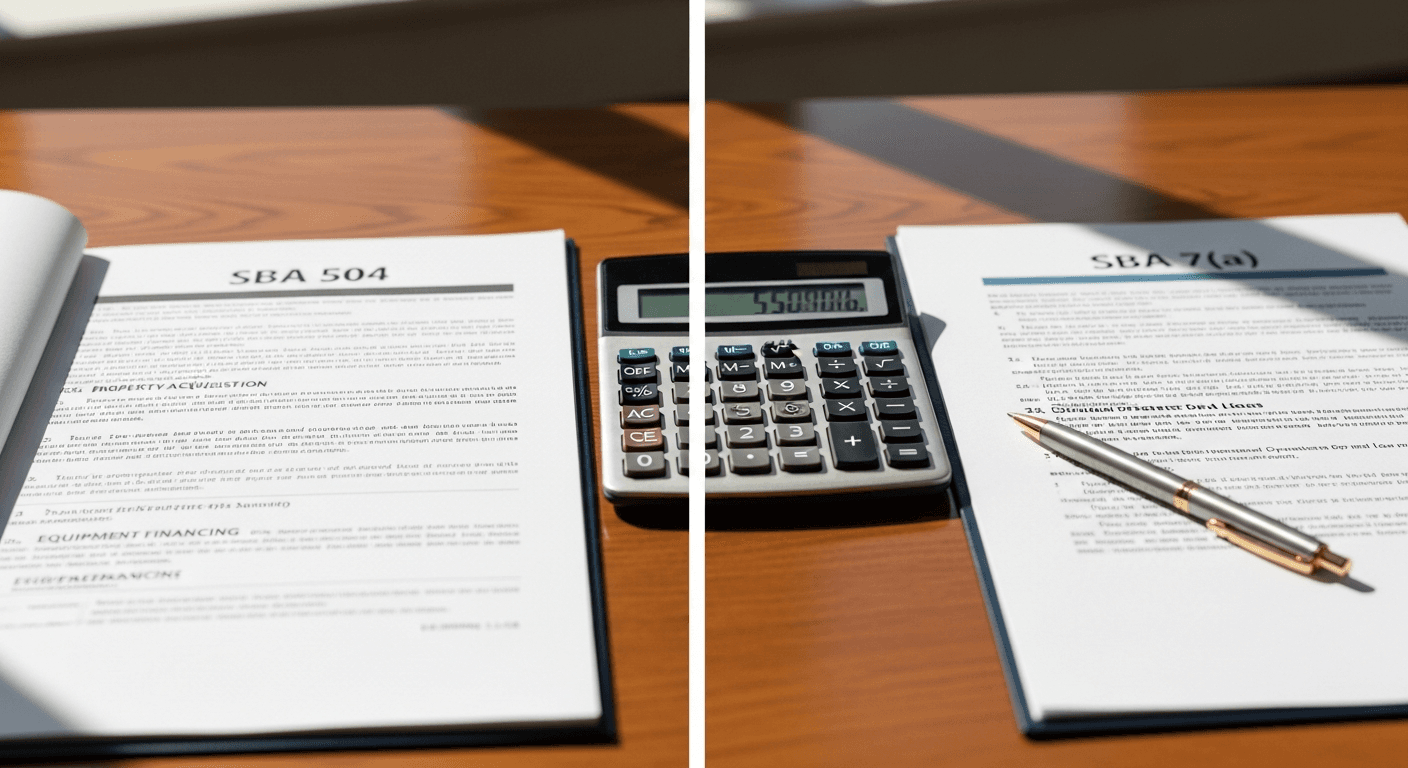
SBA 504 Loan vs 7(a) Cost: Which Saves You More in 2026?
SBA 504 Loan vs 7(a) Cost: Which Saves You More in 2026?
Choosing between an SBA 504 loan and a 7(a) loan often comes down to total cost—and the difference can be tens of thousands of dollars over the life of your loan. SBA 504 loans cost between 6.5-7.0% APR with fixed rates and lower fees for real estate and equipment purchases over $750,000, while SBA 7(a) loans start at 7.0% APR with variable rates and more flexibility for smaller loans or working capital needs. Understanding the specific fees, interest structures, and long-term payment differences helps you choose the option that saves your business the most money.
What Is the Cost Difference Between SBA 504 and 7(a) Loans?
SBA 504 loans cost less in total interest and fees for most commercial real estate and large equipment purchases, while SBA 7(a) loans have higher rates but greater flexibility and faster closing times. The cost difference breaks down into three key areas: interest rates, upfront fees, and total payments over time.
As of April 2026, SBA 504 loans carry fixed interest rates starting at 6.5% APR for the CDC portion (which covers 40% of the project), while the bank portion (50% of the project) typically ranges from 6.0-7.5% depending on your lender and creditworthiness. This creates a blended rate of approximately 6.5-7.2% for most borrowers. SBA 7(a) loans, by contrast, start at 7.0% APR and can reach 9.5% or higher depending on loan size, term, and whether you choose a variable or fixed rate structure.
For a concrete example: On a $1 million commercial real estate purchase with a 25-year term, a 504 loan at 6.8% blended rate costs approximately $6,820 per month with total interest of $1,046,000 over the life of the loan. The same purchase financed with a 7(a) loan at 8.0% costs $7,718 per month with total interest of $1,315,400—a difference of $269,400 in interest alone.
The fee structures also differ significantly. SBA 504 loans charge a 0.5% CDC processing fee (capped at $6,000-$7,500 depending on the CDC), a 0.5% SBA guarantee fee on the debenture portion, and standard title, appraisal, and environmental fees that typically total 3-4% of the loan amount. SBA 7(a) loans charge a 2.0-3.75% SBA guarantee fee based on loan size, plus lender packaging fees that can range from 1-3% depending on complexity, resulting in total upfront costs of 4-6% of the loan amount.
How Much Does It Actually Cost to Close an SBA 504 vs 7(a) Loan?
Closing costs for an SBA 504 loan typically range from 3-4% of the total project cost, while SBA 7(a) closing costs run 4-6% of the loan amount. These costs include SBA guarantee fees, lender fees, third-party reports, and legal expenses—and the timeline affects your carrying costs.
For a $500,000 SBA 504 loan (part of a $1 million project with 10% down payment), expect these specific costs:
- CDC processing fee: $3,000-$4,000 (0.5% capped)
- SBA guarantee fee on debenture: $1,000 (0.5% of $200,000 CDC portion)
- Bank origination fee: $3,000-$5,000 (0.6-1% of bank portion)
- Appraisal: $3,000-$6,000 (commercial properties)
- Environmental Phase I: $2,000-$4,000
- Title insurance and legal: $3,000-$5,000
- Miscellaneous (credit reports, surveys): $1,000-$2,000
- SBA guarantee fee: $12,500 (2.5% for loans $500K-$1M)
- Lender packaging fee: $5,000-$15,000 (1-3%)
- Appraisal: $3,000-$6,000
- Environmental review: $2,000-$4,000
- Legal and closing: $3,000-$5,000
- Miscellaneous: $1,000-$2,000
- 0.5% on the CDC debenture portion only
- For a $1 million project: 0.5% × $400,000 CDC portion = $2,000
- CDC processing fees are capped at $6,000-$7,500 regardless of loan size
- Loans ≤$150,000: 0% (waived through September 2026 under current SBA initiatives)
- Loans $150,001-$700,000: 2.0%
- Loans $700,001-$1,000,000: 3.0%
- Loans $1,000,001-$5,000,000: 3.5%
- Loans over $5,000,000: 3.75%
- CDC annual servicing fee: $500-$1,000 for the life of the loan
- Third-party reports (environmental, appraisal, survey): $6,000-$12,000
- Typically no prepayment penalty after 10 years
- Lender packaging fees: 1-3% (negotiable, often higher for complex deals)
- Ongoing servicing fees: typically built into interest rate
- Prepayment penalties possible in first 3 years for loans over $150,000
- CDC portion: $400,000 at 6.4% fixed
- Bank portion: $500,000 at 6.8% fixed (negotiated)
- Blended effective rate: ~6.6% fixed for 20-25 years
- Loans under $25,000: Prime + 4.25-4.75%
- Loans $25,000-$50,000: Prime + 3.25-3.75%
- Loans over $50,000: Prime + 2.25-2.75%
- 504 at 6.6%: $3,385/month → $1,015,500 total paid
- 7(a) at 8.5%: $4,052/month → $1,215,600 total paid
- Difference: $667/month or $200,100 over life of loan
- Manufacturing equipment: CNC machines, industrial presses, assembly line equipment
- Heavy construction equipment: Excavators, cranes, specialized trucks
- Medical equipment: MRI machines, surgical robots, dialysis equipment
- Food service equipment: Commercial ovens, refrigeration systems, processing lines
- SBA 504 payment: $8,625/month
- Total interest paid: $285,000
- Monthly cost per $1,000 borrowed: $11.50
- SBA 7(a) payment: $9,245/month
- Total interest paid: $359,400
- Monthly cost per $1,000 borrowed: $12.33
- Difference: $620/month or $74,400 over 10 years
- Technology equipment with 3-7 year useful life (computers, software, point-of-sale systems)
- Equipment purchases under $250,000 where 504's complexity isn't justified
- Time-sensitive purchases where the 30-45 day 7(a) timeline beats 504's 60-90 days
- Mixed-use funding needs (equipment plus working capital for installation/training)
- Application and initial underwriting: 7-14 days
- Bank approval of 50% first lien: 14-21 days
- CDC underwriting and approval: 14-21 days
- SBA approval: 7-10 days
- Third-party reports (environmental, appraisal): 14-30 days (concurrent)
- Debenture pool funding: 10-20 days
- Closing: 3-5 days
- Application and underwriting: 7-14 days
- SBA approval (or PLP lender decision): 5-10 days
- Third-party reports: 10-20 days (concurrent)
- Final underwriting and closing: 5-10 days
- Total cost of ownership over your full loan term (not just closing costs)
- Timeline impact on your specific opportunity costs
- Rate lock strategies if you choose 7(a) to minimize variable rate risk
- Blended 504 rate optimization by matching you with competitive bank partners
Total 504 closing costs: $16,000-$27,000 (3.2-5.4% of loan amount)
For a comparable $500,000 SBA 7(a) loan:
Total 7(a) closing costs: $26,500-$44,500 (5.3-8.9% of loan amount)
The timeline difference also affects costs. SBA 504 loans typically close in 60-90 days due to the two-lender structure and SBA debenture pool funding schedule. SBA 7(a) loans close in 30-45 days with a single lender. If you're carrying interim financing, bridge loan interest, or losing rental income during the process, a 30-45 day delay on a 504 loan could cost an additional $2,000-$5,000 in carrying costs—though this is still typically less than the interest rate savings over the loan term.
Why Are SBA 504 Loans Cheaper Than 7(a) Loans for Real Estate?
SBA 504 loans cost less for real estate because they use fixed-rate government-backed debentures funded through bond markets, which carry lower interest rates than bank-funded variable-rate 7(a) loans. The structure itself creates cost advantages that compound over 20-25 year terms.
The SBA 504 program was specifically designed for economic development and job creation through fixed-asset financing. Certified Development Companies (CDCs) package the 40% CDC portion of 504 loans into debentures sold to investors in bond markets. These debentures carry the full faith and credit guarantee of the U.S. government, allowing them to price at lower rates—typically 1-2% below commercial real estate loan rates.
The 50% bank portion of a 504 loan also benefits from reduced risk because the bank only finances half the project (compared to 85-90% in a 7(a) loan), and the bank's lien position is secured by both the borrower's equity and the SBA-guaranteed CDC portion. This lower loan-to-value ratio allows banks to offer more competitive rates on the first-position mortgage.
SBA 7(a) loans, while more flexible, are priced at prime rate plus a spread (typically 2.25-2.75% for loans under $50,000, or 1.75-2.5% for larger loans). As of April 2026, with prime rate at 6.75%, this puts most 7(a) loans in the 8.5-9.25% range. These loans are also typically variable-rate unless you negotiate a fixed-rate structure with your lender, which carries an additional premium of 0.25-0.50%.
For real estate specifically, the 25-year amortization available on 504 loans (versus 25 years maximum on 7a loans for real estate) spreads payments over a longer period, reducing monthly costs. On a $750,000 real estate loan, the difference between a 6.8% fixed 504 loan and an 8.0% variable 7(a) loan is approximately $675 per month—$8,100 annually or $202,500 over 25 years.
Which Loan Has Lower Fees: SBA 504 or 7(a)?
SBA 504 loans have lower total fees for loans over $500,000, while SBA 7(a) loans may have lower fees for smaller loans under $250,000 due to simplified processing. The fee structure changes at different loan thresholds.
The SBA guarantee fee structure heavily favors 504 loans at higher amounts:
SBA 504 Guarantee Fees:
SBA 7(a) Guarantee Fees (2026 rates):
For a $1 million loan, the 7(a) guarantee fee alone is $30,000 (3.0%), compared to just $2,000 for the 504 program—a $28,000 difference.
However, for loans under $250,000, the math shifts. A $200,000 7(a) loan carries a $4,000 guarantee fee (2.0%), plus potentially simplified underwriting with lower lender fees if you work with an SBA Preferred Lender. A $200,000 504 loan still requires the full CDC process, environmental review, and multi-party closing, which may not justify the marginal rate savings on smaller amounts.
Additional fees to compare:
504-Specific Costs:
7(a)-Specific Costs:
How Do Interest Rates Compare Between SBA 504 and 7(a) Loans?
SBA 504 loans offer fixed interest rates starting at 6.5% APR (blended rate), while SBA 7(a) loans start at 7.0% APR and are typically variable, making 504 loans 0.5-2.0% cheaper for most borrowers. The rate structure differences create distinct advantages depending on your risk tolerance and market outlook.
The 504 rate structure uses a two-loan approach. The CDC portion (40% of project) is funded through 20-year debentures with rates set monthly based on 10-year Treasury yields plus a spread. As of April 2026, CDC debenture rates are approximately 6.2-6.5%. The bank portion (50% of project) is negotiated directly with your lender and typically ranges from 6.0-7.5% based on creditworthiness. Your 10% equity injection covers the remainder.
For example, on a $1 million project:
SBA 7(a) rates are calculated as prime rate plus a lender spread:
With prime at 6.75% (April 2026), most 7(a) loans range from 9.0-9.5% for variable-rate structures. Fixed-rate 7(a) loans are available but carry an additional 0.25-0.50% premium, putting them at 9.25-10.0% for most borrowers.
The rate impact on monthly payments is substantial:
$500,000 Loan, 25-Year Term:
Interest rate risk also differs. The 504's fixed structure protects you from rate increases over the 20-25 year term. If prime rate rises to 8.0% in coming years (as some economists project given 2026 inflation trends), a variable 7(a) loan could adjust to 10.25-10.75%, increasing monthly payments by $150-$300 on a $500,000 loan. The 504 rate remains locked regardless of market conditions.
Should You Choose SBA 504 or 7(a) for Equipment Financing?
Choose SBA 504 for equipment purchases over $500,000 that you'll use for 10+ years, and choose SBA 7(a) for equipment under $500,000, technology with shorter useful life, or when you need faster funding. The equipment type, cost, and expected useful life determine which loan saves you more.
SBA 504 loans can finance equipment with a useful life of at least 10 years, with loan terms matching the equipment's expected lifespan (typically 10 years for equipment, 20 years if combined with real estate). The lower interest rate makes 504 attractive for:
For a $750,000 equipment purchase at 6.8% over 10 years:
The same equipment financed with a 7(a) loan at 8.5% over 10 years:
However, SBA 7(a) loans make more sense for:
Keep in mind that equipment-only 504 loans require at least $250,000 in financing to be cost-effective, as the CDC processing fees and third-party reports create a fixed cost floor. For a $150,000 equipment purchase, the $8,000-$12,000 in 504 closing costs represents 5.3-8.0% of the loan amount, eroding the interest rate advantage. A 7(a) loan with 5.0% total closing costs ($7,500) and a 1.5% higher rate may actually cost less over a shorter term.
What About Closing Timeline and Speed-to-Funding Costs?
SBA 7(a) loans close 30-60 days faster than 504 loans, which can save $5,000-$15,000 in carrying costs and lost opportunity, but this rarely offsets the long-term interest savings of 504 loans for deals over $750,000. Understanding the timeline cost is essential for time-sensitive purchases.
SBA 504 loan timeline (typical 60-90 days):
SBA 7(a) loan timeline (typical 30-45 days):
The 30-45 day difference matters most when:
Carrying bridge financing: If you're using interim financing at 9-12% while waiting for SBA approval, the 45-day delay on a $500,000 loan costs approximately $5,625 in extra interest (assuming 9% bridge rate and 45-day delay). This is real cost, but still less than the $74,400 you'd save over 10 years with a lower-rate 504 loan.
Missing purchase opportunities: In competitive real estate markets, sellers may accept offers with 30-day closings over 90-day closings. If a 504 timeline costs you a property that appreciates $50,000 in six months while you find another opportunity, the speed cost is measurable. However, if you're purchasing owner-occupied real estate for long-term use, the $200,000+ in interest savings over 25 years makes the wait worthwhile.
Losing rental income: If you're purchasing a building with tenants and can't access rental income until closing, the 45-day delay at $8,000/month in rent costs $12,000. This is a real timeline cost to factor into your decision.
Operating equipment delays: If new equipment would generate $15,000/month in additional revenue, the 45-day delay costs $22,500 in lost opportunity. For equipment deals under $500,000, this makes 7(a)'s speed advantage compelling.
At 3A Lending LLC, Noah and the team help you model these timeline costs against interest rate savings to make data-driven decisions. For most real estate deals over $750,000, the long-term savings outweigh timeline costs. For equipment under $500,000 or time-sensitive opportunities, 7(a) speed often wins.
How 3A Lending LLC Helps You Choose the Lowest-Cost SBA Loan Option
At 3A Lending LLC, we shop your deal across multiple SBA lenders in all 50 states to find the absolute lowest cost option for your specific situation—whether that's a 504, 7(a), or alternative financing structure. Based in Fort Wayne, Indiana, we provide Midwestern reliability and personal service without the 1-800 number experience.
Noah and our team analyze:
We provide 24-hour pre-approval and never charge application or pre-qualification fees. Our lender network includes both SBA Preferred Lenders (for fastest 7a approvals) and experienced CDCs (for lowest-cost 504 structures).
Whether you need SBA 504 loans starting at 6.5% APR for commercial real estate, SBA 7(a) loans starting at 7.0% APR for working capital or mixed-use purchases, or equipment financing for specialized machinery, we structure the deal that saves you the most money over time—not just at closing.
Contact us at (260) 201-1112 for a no-cost analysis of your specific scenario. We'll model both 504 and 7(a) options with real numbers, real timelines, and real total cost projections.
Frequently Asked Questions
What is the main cost difference between SBA 504 and 7(a) loans?
SBA 504 loans typically cost 1-2% less in interest rates (6.5-7.0% vs. 7.0-9.5%) and have lower fees for loans over $500,000, resulting in savings of $50,000-$200,000 over a typical 20-25 year term compared to 7(a) loans.
Can you use an SBA 504 loan for working capital like you can with a 7(a)?
No, SBA 504 loans can only finance fixed assets like real estate and equipment with useful lives of 10+ years. SBA 7(a) loans can finance working capital, inventory, debt refinancing, and business acquisitions in addition to fixed assets, making them more flexible despite higher costs.
Are SBA 504 closing costs tax deductible?
Yes, most SBA 504 closing costs (guarantee fees, CDC fees, appraisal, legal) are tax deductible as business expenses in the year paid or amortized over the loan term. Consult your CPA to determine the optimal tax treatment for your situation.
How much can I save with an SBA 504 loan on a $1 million real estate purchase?
On a $1 million property with a 25-year term, a 504 loan at 6.8% saves approximately $269,000 in total interest compared to a 7(a) loan at 8.0%, plus an additional $28,000 in lower guarantee fees—a total savings of nearly $297,000 over the life of the loan.
Do SBA 7(a) loans have prepayment penalties that increase costs?
SBA 7(a) loans over $150,000 may have prepayment penalties in the first three years (5% in year one, 3% in year two, 1% in year three). SBA 504 loans typically have no prepayment penalties after 10 years, making them better for borrowers who may refinance or sell.
Which loan is cheaper for purchasing a business?
SBA 7(a) loans are typically the only option for business acquisitions since 504 loans cannot finance intangible assets like goodwill, customer lists, or going-concern value. The 7(a) program specifically allows up to 90% financing of business purchase price plus working capital.
Can I get a fixed rate on an SBA 7(a) loan to match 504 stability?
Yes, many SBA lenders offer fixed-rate 7(a) loans, but expect to pay an additional 0.25-0.50% premium over variable rates, putting fixed 7(a) loans at 9.25-10.0% in the current market—still 2-3% higher than typical 504 blended rates.
3A Lending
SBA Loan Experts
Ready to explore your financing options?
Get pre-qualified in 24 hours. 3A Lending shops your deal across multiple lenders to find the best rates and terms.
Get Pre-Qualified