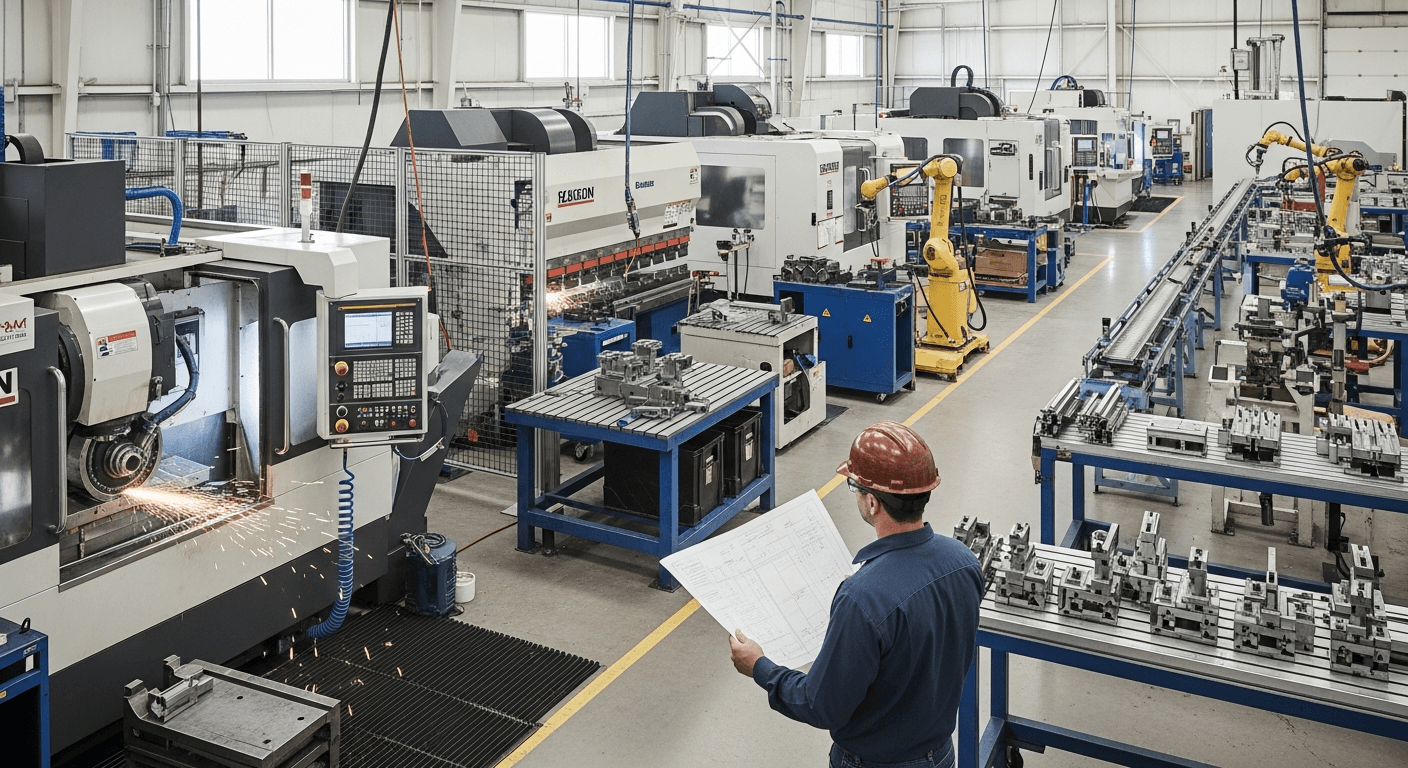
SBA 504 Loan Manufacturing Expansion: Complete 2026 Guide
SBA 504 Loan Manufacturing Expansion: Complete 2026 Guide
Manufacturing expansion requires substantial capital investment, and SBA 504 loans for manufacturing expansion provide one of the most cost-effective financing solutions available in 2026. With fixed rates starting at 6.5% APR, up to $5.5 million in funding, and 10-25 year terms, 504 loans have become the preferred choice for manufacturers purchasing facilities, upgrading production lines, or acquiring new equipment.
Under the Made in America Manufacturing Initiative extended through September 2026, qualifying manufacturers can access fee waivers that reduce total borrowing costs by $15,000-$30,000 compared to previous years. This guide examines exactly how 504 loans work for manufacturing expansion, what the approval process entails, and when this financing structure delivers the best value.
What Is a 504 Loan and How Does It Work for Manufacturing Expansion?
An SBA 504 loan is a three-party financing structure designed specifically for fixed asset purchases that promote business growth and job creation. For manufacturing expansion, this means purchasing commercial real estate, constructing new facilities, or acquiring heavy machinery with useful lives exceeding 10 years.
The financing structure splits the total project cost into three components: a conventional lender provides 50% of the funding, a Certified Development Company (CDC) contributes 40% backed by an SBA guarantee, and the borrower contributes 10% as a down payment. This structure allows manufacturers to preserve working capital while securing long-term fixed-rate financing for major capital investments.
A 504 loan works particularly well for manufacturing expansion because it covers both real estate and equipment in a single transaction. When a food manufacturer in Ohio expanded their facility in early 2026, they used a $3.2 million 504 loan to purchase an adjacent 45,000 square foot building ($2.1M) and install new automated packaging equipment ($1.1M). The three-party structure meant they only needed $320,000 in cash—preserving $960,000 in working capital compared to a traditional 30% down payment requirement.
The CDC portion carries a fixed interest rate tied to 5-year or 10-year Treasury rates plus a spread of approximately 2.39-2.63%, resulting in current effective rates between 6.5-7.2% APR depending on market conditions in Q2 2026. The conventional lender sets their own rate (typically Prime + 1-2%), which currently ranges from 8.5-10% APR. Because the CDC portion represents 40% of the total loan at the lower fixed rate, the blended effective rate for the entire project remains highly competitive.
How Much Can a Small Manufacturing Business Borrow Through a 504 Loan for Expansion?
Manufacturing businesses can borrow up to $5.5 million through a standard 504 loan, with certain qualifying projects eligible for increased limits. The actual amount depends on the total project cost, which includes the purchase price, construction costs, equipment expenses, and eligible soft costs like appraisals, environmental reports, and legal fees.
For manufacturers focused on achieving specific policy goals, the SBA offers enhanced lending limits. Energy-efficient manufacturing projects that reduce energy consumption by at least 10% qualify for up to $5.5 million per project. Manufacturers in designated opportunity zones or rural areas can access similar enhanced limits. A metal fabrication shop in rural Indiana recently secured a $4.8 million 504 loan to build a new 62,000 square foot facility with solar panels and LED lighting systems, qualifying for the energy efficiency enhancement.
The total project cost calculation matters because it determines the actual cash required. If a manufacturer needs $4 million in total financing, the structure typically breaks down as: conventional lender provides $2 million (50%), CDC provides $1.6 million (40%), and the business contributes $400,000 (10%). However, manufacturers purchasing existing buildings occupied by their business for two years prior may qualify for a reduced 5% down payment under certain circumstances.
It's important to note that 504 loan limits apply per project, not per business. A growing precision manufacturing company could potentially use one 504 loan for facility expansion and a separate 504 loan for a second facility in a different location, as long as each project meets SBA requirements and the business maintains sufficient debt service coverage.
What Are the Eligibility Requirements for a 504 Loan in the Manufacturing Industry?
Manufacturing businesses must meet four core eligibility criteria to qualify for a 504 loan: SBA size standards, for-profit operating structure, tangible net worth below $15 million, and average net income below $5 million after taxes for the preceding two years.
SBA size standards for manufacturers (see SBA size standards table) are typically defined by number of employees rather than revenue. Most manufacturing NAICS codes allow up to 500-1,500 employees depending on the specific industry segment. Food manufacturing (NAICS 311) allows up to 500-1,250 employees depending on the product category, while fabricated metal product manufacturing (NAICS 332) generally permits up to 1,000 employees. A precision machining shop with 150 employees and $45 million in annual revenue easily qualifies under these standards.
Beyond size standards, lenders evaluate debt service coverage ratio (DSCR) to determine repayment capacity. Most require a minimum DSCR of 1.25x, meaning the business must generate $1.25 in cash flow for every $1.00 in annual debt service. A manufacturer with $800,000 in annual net operating income could support approximately $640,000 in annual debt payments. Over a 20-year term at 7% APR, this supports roughly $6.7 million in total borrowing capacity.
Credit requirements focus on both business and personal credit profiles. While no absolute minimum credit score exists, most CDCs and conventional lenders prefer personal credit scores above 680 and no major derogatory marks within the past 12 months. Business credit should demonstrate a pattern of timely vendor and lender payments. A manufacturer with a 720 personal credit score but three 60-day late payments to suppliers in the past year might face additional scrutiny or require a larger down payment.
Collateral and personal guarantee requirements are standard. The purchased real estate and equipment serve as primary collateral, and the SBA requires personal guarantees from all owners with 20% or more equity stake. Unlike some conventional loans, 504 loans don't typically require blanket liens on all business assets, which helps manufacturers maintain flexibility for working capital lines of credit.
How Long Does It Take to Get Approved for a 504 Loan for Manufacturing Expansion?
The typical 504 loan approval timeline runs 60-90 days from application to closing, with the process divided into distinct phases that manufacturers can optimize through proper preparation.
The initial pre-qualification phase takes 3-5 business days. At 3A Lending LLC, we provide 24-hour pre-approval turnaround by evaluating basic financial metrics, project scope, and preliminary eligibility. A manufacturer submits recent tax returns, financial statements, and a project summary describing the expansion plans. This quick assessment identifies any immediate roadblocks and establishes realistic expectations before investing significant time in documentation.
The formal application and underwriting phase requires 30-45 days. During this period, the conventional lender and CDC simultaneously review detailed financial documentation, commission appraisals, conduct environmental Phase I assessments, and verify all eligibility criteria. A metal stamping company in Michigan experienced a 38-day underwriting period for their $2.9 million facility purchase, which included a 14-day appraisal process and 8-day environmental review.
SBA authorization adds another 10-15 days after the lender and CDC complete their underwriting. The SBA reviews the complete loan package to ensure compliance with all program requirements and issues final authorization. This phase is largely administrative and rarely results in denial if the CDC has properly structured the application.
Closing and funding typically occur 7-10 days after SBA authorization. The closing process involves signing loan documents, recording liens, and transferring funds. Complex transactions involving construction or multiple equipment purchases may require staged funding, extending this timeline.
Manufacturers can accelerate the process by preparing documentation in advance. Having recent CPA-compiled financial statements, updated equipment lists with serial numbers and valuations, and preliminary construction plans ready at application significantly reduces delays. One automotive parts manufacturer reduced their total timeline to 52 days by working with their accountant to prepare a detailed three-year financial projection before applying.
Why Would a Manufacturer Choose a 504 Loan vs Traditional Bank Financing for Expansion?
Manufacturers select 504 loans over traditional bank financing for three compelling advantages: lower effective interest rates, superior cash flow preservation, and extended fixed-rate terms that provide long-term payment stability.
The blended interest rate advantage becomes clear through direct comparison. A $3 million traditional bank loan for manufacturing expansion in April 2026 typically carries an 8.5-9.5% variable rate with a 15-20 year amortization. The same $3 million through a 504 structure results in an effective blended rate of approximately 7.2-7.8% fixed for the life of the loan. Over 20 years, this 1.3% rate differential saves approximately $240,000 in total interest expense.
Cash flow preservation through the lower down payment requirement provides immediate operational advantages. Traditional commercial real estate loans require 20-30% down payments, while 504 loans require only 10% (sometimes 5%). For a $4 million facility purchase, this means deploying $400,000 instead of $1.2 million—preserving $800,000 for working capital, inventory expansion, or hiring skilled workers. A plastics manufacturer in Ohio used their preserved capital to hire six additional machine operators and purchase $200,000 in raw materials to fulfill a major contract they secured during the expansion.
Fixed-rate stability over 10-25 year terms eliminates interest rate risk that plagues traditional variable-rate financing. In the current economic environment where the Federal Reserve's monetary policy creates rate volatility, manufacturers gain predictable debt service that supports accurate long-term financial planning. A food processing company that secured a 504 loan in 2023 at 6.8% APR currently pays $180,000 annually less than comparable businesses that chose variable-rate bank loans now priced at 9.2% APR.
However, 504 loans do have tradeoffs. The approval process takes longer than conventional bank financing (60-90 days vs. 30-45 days), and the structure requires more documentation and coordination between three parties. Manufacturers needing immediate funding or those purchasing assets that don't qualify (equipment under 10-year useful life, working capital, or inventory) should consider SBA 7(a) loans or conventional financing instead.
What Are the Interest Rates and Fees Associated with 504 Loans for Manufacturing?
Interest rates for 504 loans in April 2026 start at 6.5% APR for the CDC portion, with the conventional lender portion typically ranging from 8.5-10% APR, creating blended effective rates between 7.2-8.3% depending on the specific lender and project.
The CDC portion interest rate follows a formulaic structure tied to U.S. Treasury securities. For 20-year 504 loans, the rate equals the 10-year Treasury rate (currently 4.23% as of April 2026) plus a spread of approximately 2.39%, resulting in a 6.62% fixed rate. For 25-year terms, the rate uses the same Treasury benchmark plus approximately 2.63%, currently yielding 6.86% fixed. These rates are locked at loan closing and never adjust, providing complete payment certainty.
The conventional lender portion, representing 50% of the total financing, carries market-based rates that lenders set independently. Most conventional lenders price these loans at Prime Rate (currently 8.5% in April 2026) plus 1-2%, resulting in rates between 9.5-10.5% APR. Some lenders offer slightly lower rates for manufacturers with exceptional credit profiles or existing banking relationships.
Fees associated with 504 loans have decreased substantially under the Made in America Manufacturing Initiative. The standard SBA guarantee fee of 0.5% and CDC processing fee of 1.5% have been waived for qualifying manufacturing projects through September 30, 2026. On a $4 million loan, this waiver eliminates approximately $28,000 in upfront fees. Manufacturers closing loans before the September deadline should accelerate their timelines to capture these savings.
Remaining fees include conventional lender origination fees (typically 0.5-1%), third-party costs for appraisals ($3,000-$8,000 depending on property complexity), environmental Phase I assessments ($2,500-$4,000), title insurance, and legal fees. Total closing costs typically range from $15,000-$35,000 depending on project size and complexity. A precision manufacturing company in Fort Wayne recently paid $22,400 in total closing costs on a $3.7 million 504 loan—0.61% of the total loan amount.
Prepayment penalties vary by structure but are generally favorable compared to traditional commercial loans. The CDC portion typically allows prepayment without penalty after 50% of the loan term has elapsed (10 years on a 20-year loan). Some CDCs offer full prepayment flexibility from day one for an additional 0.25% fee at closing.
Can a 504 Loan Be Used to Purchase New Equipment and Machinery for Manufacturing Expansion?
Yes, 504 loans cover new equipment and machinery purchases as long as the equipment has a useful life of at least 10 years and is considered a long-term fixed asset. This includes production machinery, specialized manufacturing equipment, material handling systems, and certain technology infrastructure.
Qualifying equipment must meet specific criteria that distinguish capital equipment from shorter-lived assets. CNC machining centers, injection molding machines, industrial ovens, assembly line automation, welding robots, and metal stamping presses all typically qualify because their useful lives exceed 10 years according to IRS depreciation schedules. A medical device manufacturer in 2026 used 504 financing to purchase $1.8 million in cleanroom equipment and automated assembly machinery—all qualified because the equipment carried 15-20 year useful life classifications.
Equipment that doesn't qualify includes items with shorter useful lives like computers (typically 5-year depreciation), standard office furniture, delivery vehicles under 13,000 pounds, and most IT infrastructure. Manufacturers needing to finance these assets should consider equipment financing or SBA 7(a) loans that offer more flexibility for shorter-lived assets.
The 504 loan can combine both real estate and equipment in a single transaction, which provides significant advantages for comprehensive expansion projects. When a food manufacturer built a new 38,000 square foot facility, they structured a single $4.2 million 504 loan covering land acquisition ($420,000), building construction ($2.6 million), and installation of processing equipment ($1.18 million). This unified approach simplified financing, reduced closing costs, and provided a single monthly payment structure.
Equipment must be purchased for use in the business operations—not for resale or rental to other parties. The manufacturer must occupy at least 51% of the facility where the equipment operates if real estate is included in the financing. For equipment-only 504 loans (less common but available), the equipment itself serves as primary collateral alongside any existing real estate the business owns.
One important consideration: the equipment must be purchased, not leased or under a lease-to-own arrangement being converted. A plastics manufacturer attempting to use 504 financing to buy out an existing equipment lease discovered they needed conventional equipment financing instead because the 504 structure requires direct purchase transactions.
What Is the Difference Between a 504 Loan and a 7(a) Loan for Manufacturing Business Expansion?
The fundamental difference between 504 loans and 7(a) loans centers on purpose, structure, and flexibility—with 504 loans optimized for fixed asset purchases and 7(a) loans offering broader use cases including working capital and business acquisitions.
Loan structure represents the most significant operational difference. 504 loans require three-party financing (bank, CDC, borrower) with a rigid 50/40/10 split, while 7(a) loans involve only two parties (bank and borrower) with the SBA guaranteeing up to 85% of the loan. A manufacturer using a 504 loan coordinates with multiple entities throughout the process, whereas a 7(a) loan applicant works exclusively with a single SBA-approved lender.
Eligible use cases determine which product fits specific expansion needs. 504 loans exclusively finance fixed assets: real estate, buildings, and long-term equipment. 7(a) loans cover these same assets plus working capital, inventory, business acquisitions, debt refinancing, and shorter-lived equipment. When an automotive parts manufacturer wanted to expand their facility ($2.1M) and increase inventory to support new contracts ($600K), they needed a 7(a) loan because 504 loans cannot finance inventory or working capital.
Maximum loan amounts differ substantially. 504 loans cap at $5.5 million for most manufacturing projects, while 7(a) loans max out at $5 million but can be combined with other 7(a) loans for larger total borrowing. However, the 504 structure allows manufacturers to borrow more relative to their down payment—a $5 million 504 loan requires $500K down (10%), while a $5 million 7(a) loan typically requires $500K-$750K down (10-15%).
Interest rate structures heavily favor 504 loans for long-term fixed asset purchases. The blended 504 rate currently ranges 7.2-8.3% APR fixed for 10-25 years, while 7(a) loans typically carry variable rates of 8.5-10.5% APR (Prime + 2.75% on loans over $50K). Over a 20-year period, a manufacturer borrowing $3 million saves approximately $180,000-$280,000 in total interest with a 504 loan compared to a 7(a) loan, assuming rates increase 1.5% over the loan term.
Repayment terms extend longer on 504 loans. Real estate financed through 504 loans carries 20-25 year terms, while 7(a) loans typically max out at 25 years for real estate but average 10-15 years in practice. Equipment financing through 504 loans provides terms matching the equipment's useful life (up to 20 years for heavy machinery), while 7(a) equipment loans rarely exceed 10 years.
Speed and complexity favor 7(a) loans for manufacturers needing faster execution. The two-party 7(a) structure typically closes in 30-45 days, while the three-party 504 process requires 60-90 days. A metal fabrication shop needing to close on a facility purchase within 45 days to meet a seller's deadline chose a 7(a) loan despite the higher interest rate because the 504 timeline wouldn't meet the requirement.
A precision manufacturing company in Fort Wayne evaluated both options for a $3.8 million expansion involving land purchase ($400K), new building construction ($2.6M), and equipment installation ($800K). They selected the 504 structure because the project was exclusively fixed assets, the longer timeline posed no issues, and the fixed-rate structure saved approximately $240,000 in total interest over 20 years compared to the 7(a) alternative.
How 3A Lending LLC Can Help with Your Manufacturing Expansion
At 3A Lending LLC, we specialize in connecting manufacturers across all 50 states with the optimal SBA financing for their expansion projects. Our Fort Wayne-based team understands the unique capital requirements manufacturers face when scaling production capacity, upgrading equipment, or acquiring additional facilities.
We shop your 504 loan application across our network of Certified Development Companies and conventional lenders to secure the best rates and terms available. Unlike working directly with a single CDC or bank, our multi-lender approach in April 2026 has delivered rate savings averaging 0.3-0.6% APR compared to manufacturers who approached lenders individually. On a $4 million loan over 20 years, this translates to $48,000-$96,000 in total interest savings.
Our pre-qualification process provides 24-hour turnaround so you know exactly where you stand before investing significant time in documentation. We analyze your financial position, review your expansion plans, and identify potential qualification issues upfront—eliminating surprises during the formal underwriting process. A medical device manufacturer recently received pre-qualification approval within 18 hours, allowing them to make a confident offer on a facility knowing financing was secured.
There's no fee to apply or get pre-qualified for 504 financing through 3A Lending LLC. We're compensated by lenders upon successful loan closing, which aligns our incentives with yours—we succeed when you secure the best possible financing terms for your manufacturing expansion.
Contact us at (260) 201-1112 to discuss your manufacturing expansion plans. Whether you're purchasing a new facility, installing automated production lines, or expanding into a second location, our team provides the personalized Midwestern service and multi-lender access that delivers results. We're not a 1-800 number—we're your neighbor, committed to helping American manufacturers access the capital needed to grow and thrive.
Frequently Asked Questions
Can I use a 504 loan to refinance existing manufacturing equipment debt?
No, 504 loans cannot refinance existing debt under standard program rules. The SBA 504 program is designed exclusively for new fixed asset purchases, facility construction, or equipment acquisitions. Manufacturers seeking debt refinancing should explore SBA 7(a) loan refinancing options or conventional refinancing products that allow debt consolidation.
What happens if my manufacturing business is only 2 years old?
Manufacturers in business for less than 2 years can still qualify for 504 loans, but face additional scrutiny and documentation requirements. Lenders typically require detailed business plans, personal financial statements showing sufficient liquidity, and stronger debt service coverage ratios (1.35x vs. 1.25x for established businesses). A startup precision machining shop with 18 months operating history secured 504 financing in 2026 by demonstrating 1.42x DSCR and providing personal financial statements showing $380,000 in liquid assets.
Do 504 loans require environmental assessments for manufacturing facilities?
Yes, all 504 loans involving real estate purchases require Phase I Environmental Site Assessments (ESAs) regardless of property type. Manufacturing facilities often trigger Phase II assessments if the Phase I identifies recognized environmental conditions like underground storage tanks, prior chemical use, or soil contamination. These assessments cost $2,500-$4,000 for Phase I and $8,000-$25,000 for Phase II depending on scope.
Can a manufacturer with a 640 credit score qualify for a 504 loan?
Possibly, but approval becomes more difficult with credit scores below 680. Manufacturers with 640-680 credit scores typically need compensating factors like higher down payments (15% vs. 10%), stronger debt service coverage ratios (1.40x+), or significant collateral equity to offset credit concerns. Working with an experienced SBA lender like 3A Lending LLC helps identify the optimal presentation strategy for borderline credit profiles.
What constitutes job creation requirements for 504 manufacturing loans?
Manufacturers must create or retain one job per $75,000 of SBA debenture (the CDC portion). On a $4 million total project ($1.6M CDC portion), this requires creating or retaining approximately 21 jobs. Jobs must be maintained for at least two years after project completion. Part-time employees count as half a job, and retaining existing positions satisfies this requirement if the expansion prevents layoffs.
Are there restrictions on what types of manufacturing qualify for 504 loans?
Most manufacturing types qualify, but the SBA prohibits financing for businesses primarily engaged in lending, speculation, passive real estate investment, or certain restricted industries. Food manufacturing, metal fabrication, plastics manufacturing, medical device production, automotive parts, and electronics assembly all qualify without restriction. Manufacturers producing items for export receive favorable treatment under current SBA policy encouraging American manufacturing competitiveness.
3A Lending
SBA Loan Experts
Ready to explore your financing options?
Get pre-qualified in 24 hours. 3A Lending shops your deal across multiple lenders to find the best rates and terms.
Get Pre-Qualified